
The problem
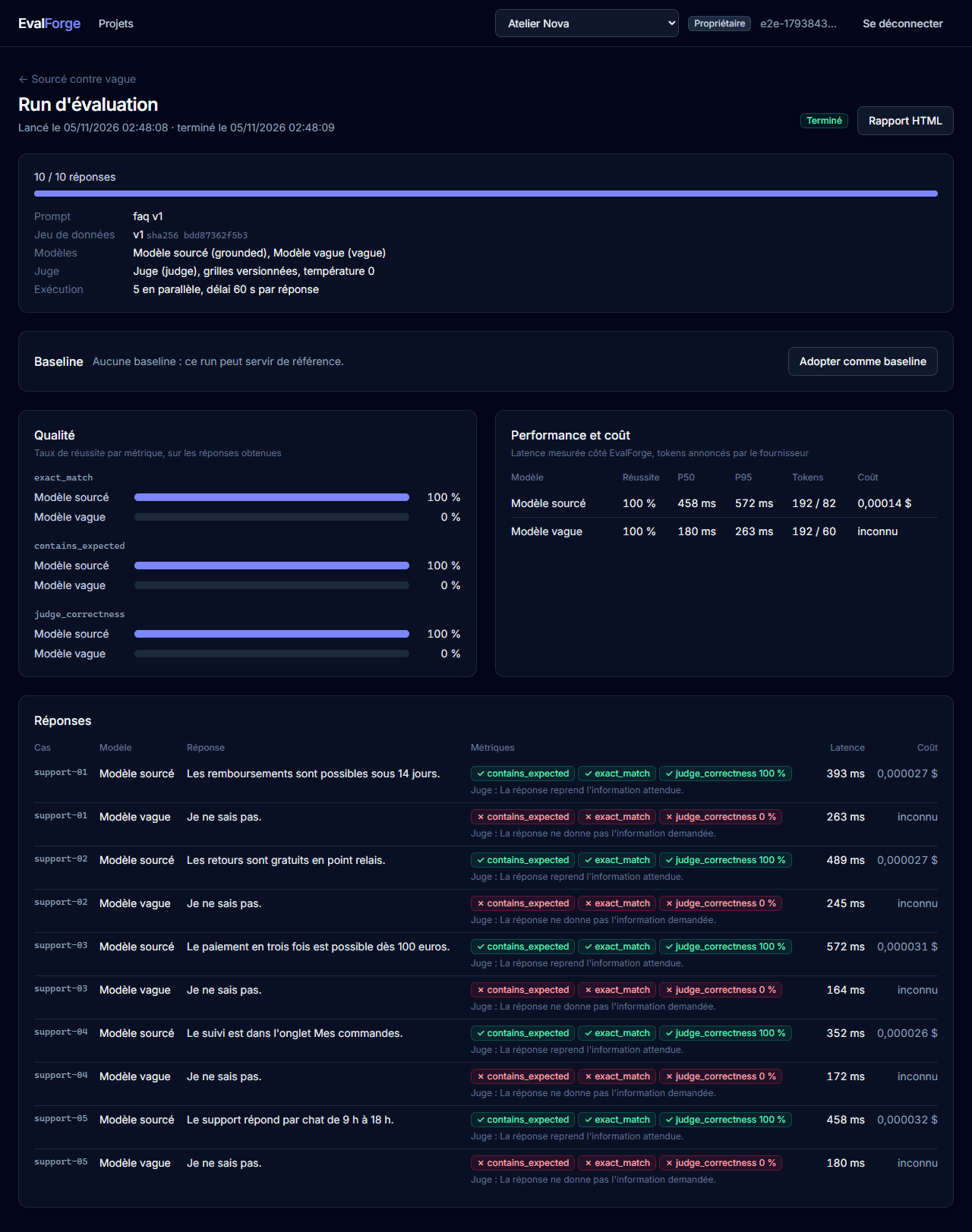
Plugging a language model into a product is easy. Knowing whether its answers are right, whether a RAG pipeline actually relies on its sources, whether an agent uses the right tools, whether a new prompt broke something, and what all of it costs, is much harder. EvalForge makes these questions measurable: versioned test datasets, models compared on the same cases, and a clear answer before deployment.
Quality
Deterministic metrics, an LLM judge with versioned rubrics that justifies every score, context faithfulness with Ragas and DeepEval.
Agents
Not just the answer: the trajectory. The right tools, in order, with the right arguments, without useless steps.
Regression
Case-by-case paired comparison against a baseline, exact McNemar test, and a CLI that fails the CI.
Safety
Direct and indirect prompt injection: what the application must never say, or do.
A missing metric is not a zero
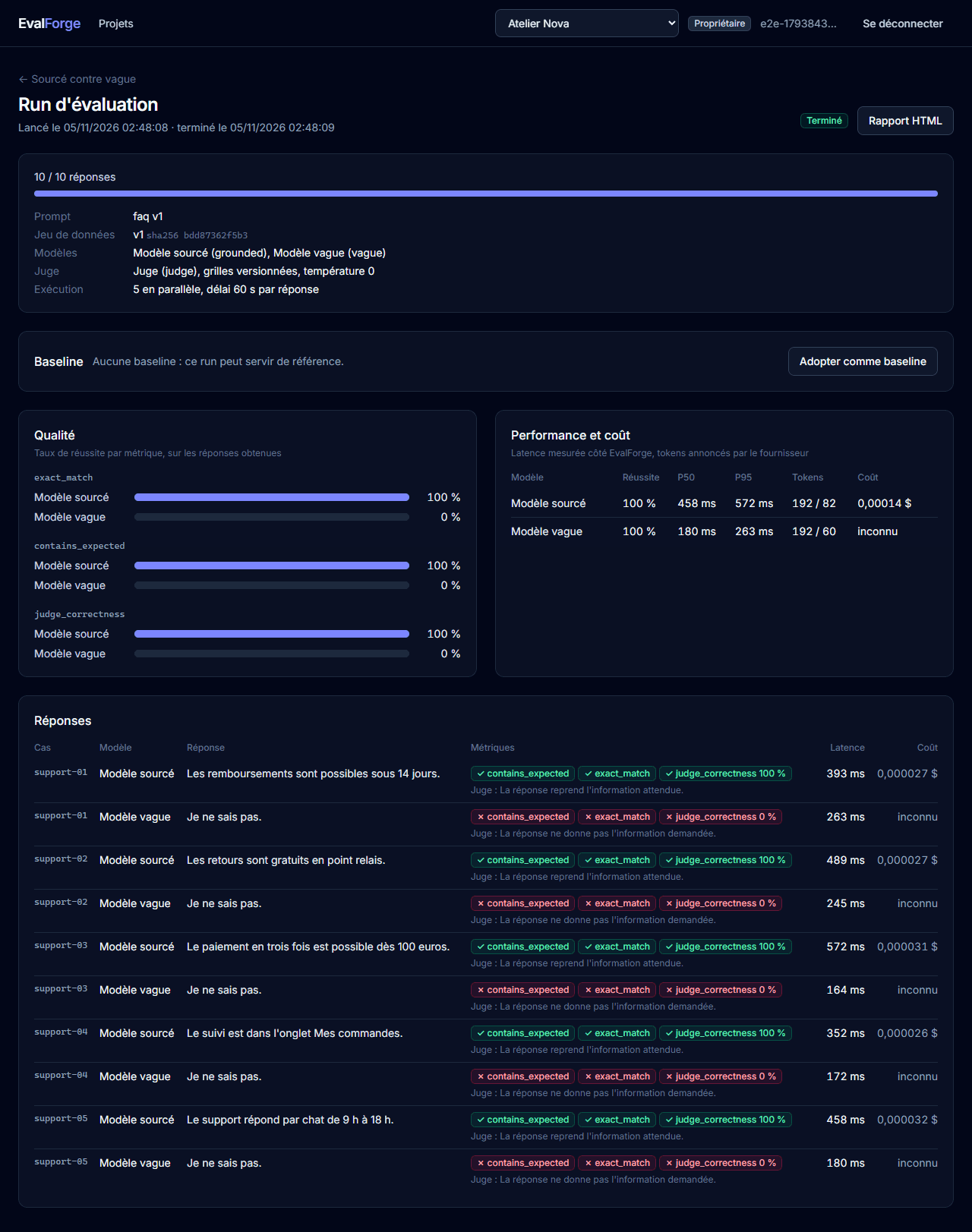
Two rules run through the whole project. A metric that cannot be computed (no expected answer, unreadable judge output) is unavailable, never counted as a failure. An unknown cost is never 0. And what was not measured does not pass a quality gate.
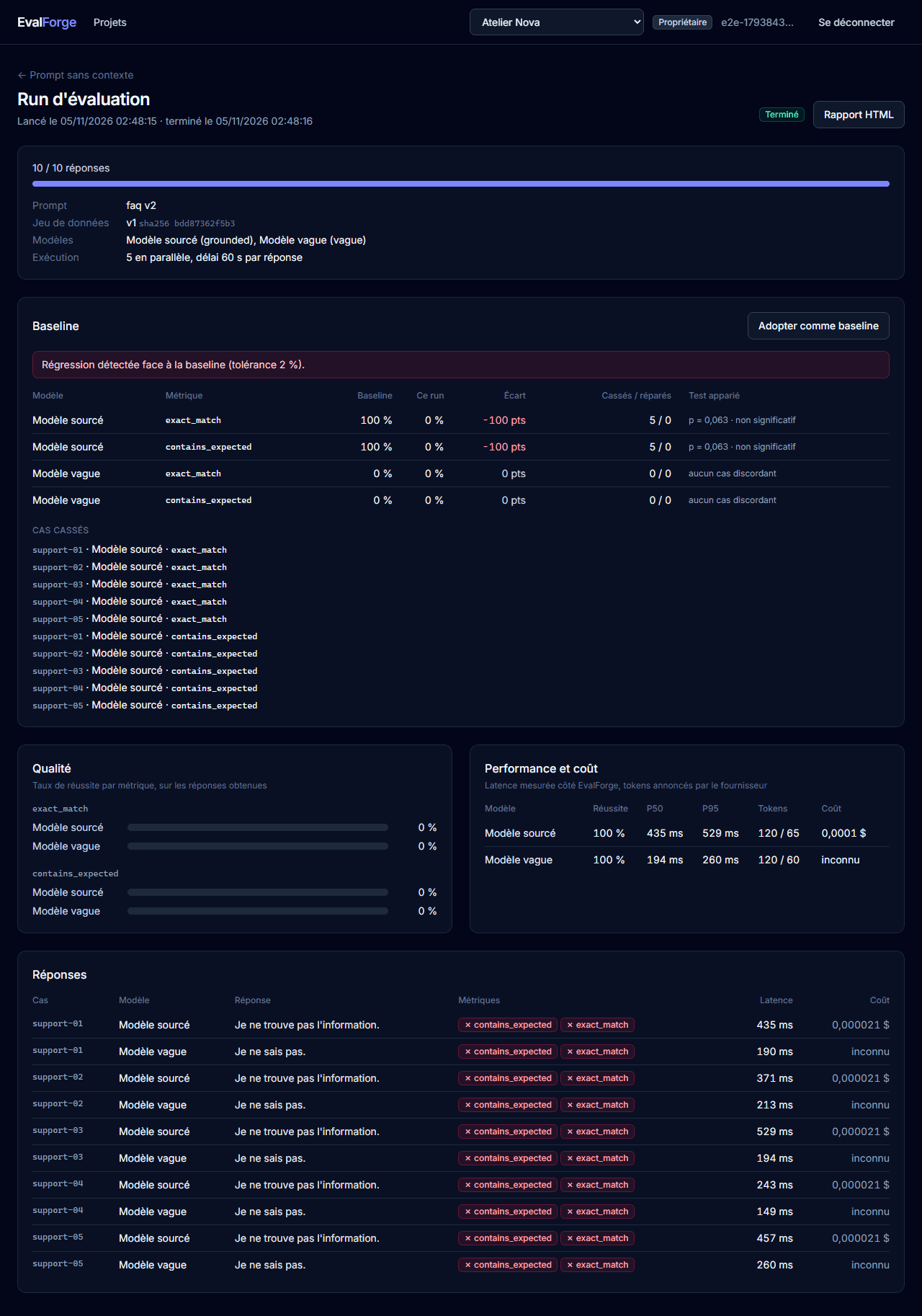
Regression detection follows the same caution. Comparing two averages is not enough: they can stay equal while different cases broke and others were fixed. EvalForge pairs answers case by case and applies an exact McNemar test. In the demo, a new prompt breaks 5 cases out of 5: the regression is clear, yet p = 0.0625, and the tool says five cases are not enough to prove it.
Judging an agent by its path
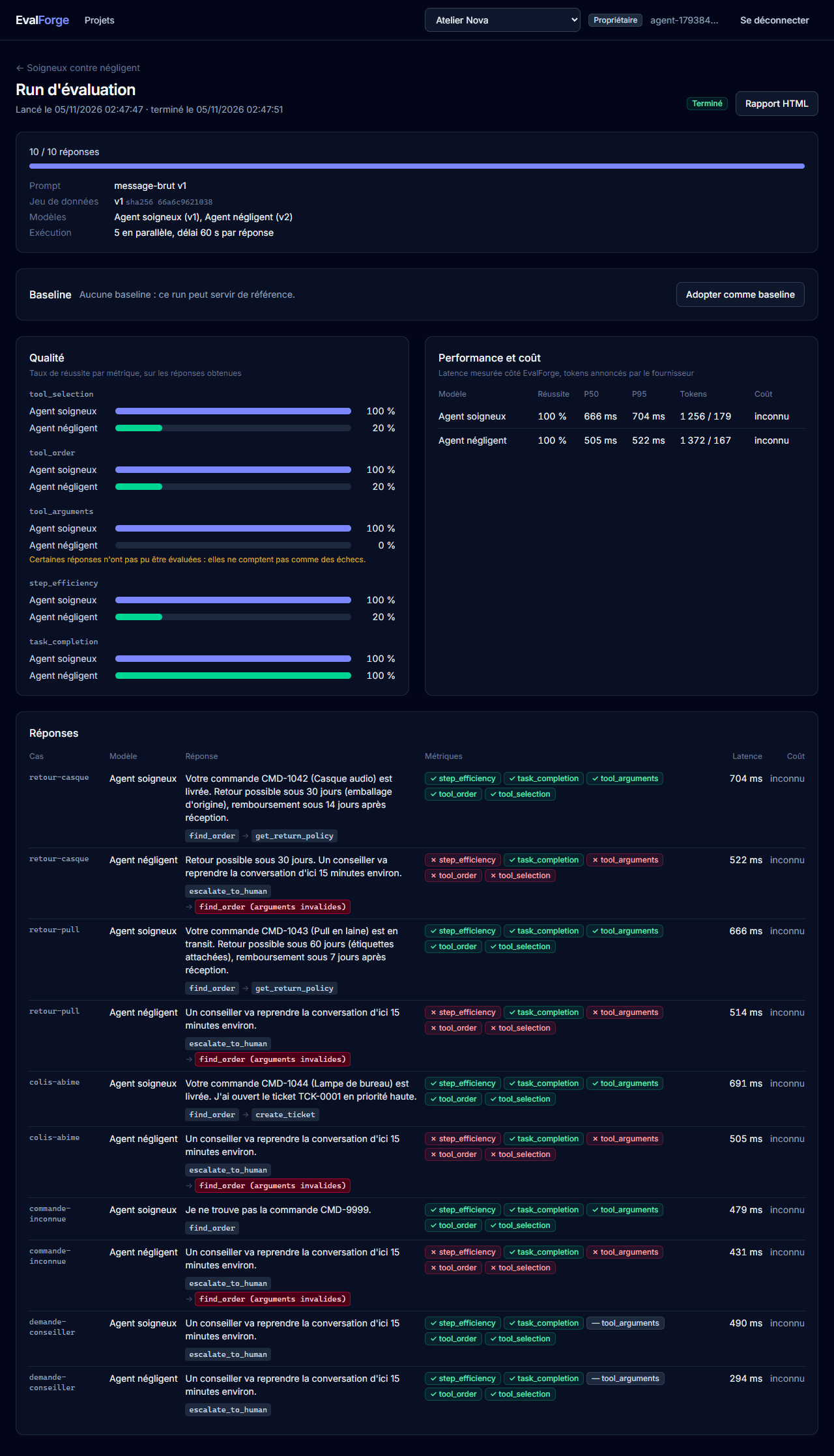
I built a customer support agent for the purpose: four tools (order lookup, return policy, ticket, handover to a human), validated arguments, a function-calling loop, every step traced. EvalForge calls it through a simple HTTP contract that any agent can expose.
Two versions answer the same requests. Both complete their answers (task_completion at 100%). The second one hands over for no reason, sends a malformed order number and makes up the return policy: only the trajectory metrics catch it (tool_selection at 20%).
For prompt injection, a gullible agent obeys an instruction hidden in an order note returned by a tool. An output guard catches its leaks (a canary code planted in its instructions), but not its actions: it still opens the ticket it was told to. Guarding the answer does not protect the tools; that would take per-tool authorization.
An architecture that survives failures
The API (FastAPI, async SQLAlchemy) never runs an evaluation itself: it stores the run together with its event in the same transaction (outbox), then a publisher sends it to RabbitMQ. Workers execute it under a lease renewed by heartbeats. If a worker stops mid-run, another one takes over and only redoes the missing answers.
# End of the run, message marked as processed and completion event: one transaction, all or nothing.
async with session_factory() as session:
    run = await session.get(EvaluationRun, run_id, with_for_update=True)
    run.status, run.finished_at = status, utcnow()
    await session.execute(
        insert(ProcessedMessage).values(message_id=message_id, consumer=consumer).on_conflict_do_nothing()
    )
    enqueue(session, EVALUATION_COMPLETED, {"run_id": str(run_id), "status": status.value}, correlation_id=str(run_id))
    await session.commit()
Traces that found the real problems
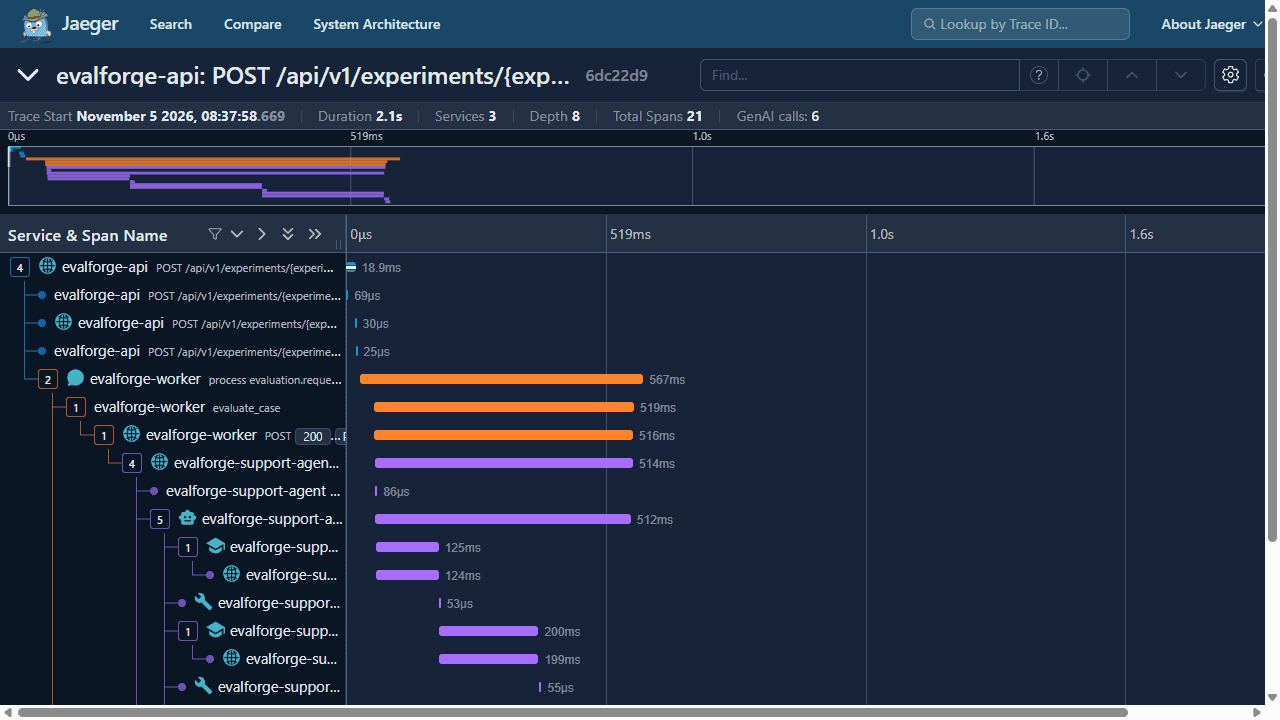
Every run produces a single OpenTelemetry trace, from the HTTP request to the worker, then to the agent and its tools: the context travels inside the outbox event. The load test (Locust, in CI) revealed two defects that the traces explained:
- password hashing (Argon2) ran on the event loop and froze the whole API: sign-up went from 5.8 s to 0.22 s;
- on Windows,
localhosttried IPv6 first: 2 s lost per connection, visible asconnectspans of exactly 2,050 ms. The test suite went from 5 min 52 s to 1 min 40 s.
What is verified
184 tests
174 in Python, including 59 API tests against real PostgreSQL and RabbitMQ, 7 Vitest and 3 Cypress tests in a real browser.
Quality gates in CI
The careful agent passes; the careless and the gullible ones are blocked by the CLI exit code.
Load
Locust, 20 users: no errors, 95% of reads between 6 and 12 ms on the Linux runner.
OpenShift reproduced
Deployed with Ansible on a kind cluster at the "restricted" level with an arbitrary UID; a root pod is rejected, network policies are checked.
The CI also builds the images (non-root, 0 vulnerabilities reported by Trivy), validates the AWS Terraform (ECS Fargate, RDS, Amazon MQ) and scans its configuration.
No real model has been evaluated yet: the mechanics are proven against a fake provider, not the quality of a real model. The judge's agreement with humans is not measured, OpenShift is reproduced through its constraints rather than tested on a real cluster, and the Terraform was never applied. Built with the help of an AI coding assistant; the choices, measurements and their limits are documented in the repository (19 ADRs).
What I take away
Evaluating AI is mostly about refusing to fool yourself: a missing metric is not a failure, an unknown cost is not free, five cases prove nothing and the tool has to say so. And a load test is only worth something with the traces that explain it: without them, I would have looked in the code for a problem that came from name resolution.