
The Problem
On an engineering and consulting services platform, contact form submissions arrive with widely varying maturity levels — from curious browsers to high-budget enterprise projects. Processing each submission manually took several hours and risked missing high-priority opportunities.
An autonomous system was needed to receive, enrich, score, and respond to prospects in under 30 seconds without compromising the quality of first contact.
Instant Response
Qualified, personalized email sent automatically to the prospect in under 30 seconds after form submission.
Automated Prioritization
Score from 1 to 10 calculated on budget, need, urgency, and company legitimacy — enriched in real-time via web search.
Workflow Architecture
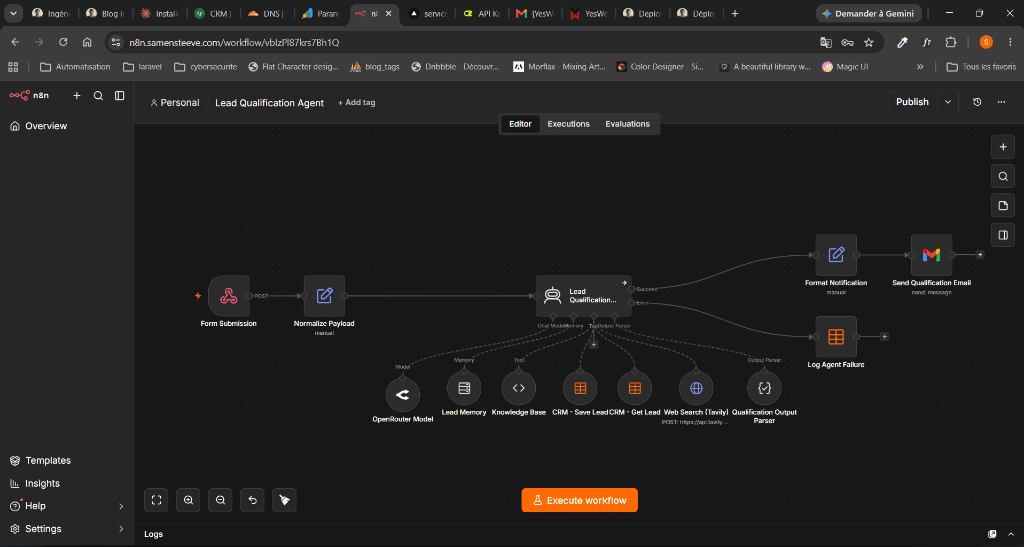
The Lead Qualification Agent n8n workflow revolves around 13 nodes organized in 5 functional groups:
Form Submission → Normalize Payload → Lead Qualification Agent
                                              │
                        ┌─────────────────────┴──────────────────────┐
                        │ Tools                                        │
                        │  • OpenRouter Model (DeepSeek v4 Flash)     │
                        │  • Lead Memory (Redis Chat Memory)          │
                        │  • Knowledge Base (service catalog)         │
                        │  • CRM - Get Lead                           │
                        │  • Web Search (Tavily)                      │
                        │  • Qualification Output Parser (strict)     │
                        └─────────────────────────────────────────────┘
                                    │
                  ┌─────────────────┴────────────────┐
               Success                             Error
                  │                                   │
      CRM - Save Lead                      Log Agent Failure
      (deterministic node)                 (error in Data Table)
                  │
      Format Notification
                  │
      Send Qualification Email
5 functional groups:
- Data Normalization: Webhook trigger → payload validation
- AI Agent & Tools: Main agent + 6 sub-nodes (model, memory, tools)
- CRM Persistence: Save Lead (deterministic, post-agent)
- Output & Notification: Email formatting → Gmail send
- Error Handling: Fallback to Data Table on failure
Webhook security: The Next.js /api/contact route forwards the submission to n8n with a Header Auth credential (n8n-webhook-secret). The webhook node validates this secret via linked credential + IP filtering (64.29.17.65, 216.198.79.65) + ignoreBots: true. No execution starts without authentication.
Redis memory: Conversation context is persisted in Redis (memoryRedisChat) — the agent retains interaction history across sessions, enabling more refined scoring on recurring contacts.
Knowledge Base as an agent tool: The full service catalog (software engineering, cloud architecture, AI automation) is injected as an agent tool. This allows the agent to precisely match the expressed need with available offerings and calibrate the response accordingly.
Tavily enrichment: The agent triggers a web search on the prospect's company name to validate its sector, size, and track record before issuing a score. Tavily and Gmail calls have retryOnFail with 3 attempts.
Deterministic CRM Save Lead: Unlike agent tools (which execute non-deterministically), the CRM - Save Lead node is a standard node in the main flow. It runs on every execution, guarantees data persistence in the CRM Data Table, and fails observably (no silent data loss).
Notification pipeline: On success, the agent's JSON output passes through Format Notification which structures the email with data passed by the agent (leadName, leadEmail, leadCompany), then Send Qualification Email delivers it in under 30 seconds. On failure, Log Agent Failure records the error in the CRM Data Table without losing contact data.
What I Built
OpenRouter orchestration: The agent runs on DeepSeek v4 Flash via OpenRouter — enabling model switching (Mistral, GPT-4o, Gemini) without modifying the agent, just changing the model identifier.
Strict Structured Output Parser with auto-fix: The agent's output is constrained to a strict JSON schema with enum for discrete choices (budget, fit, urgency), minimum/maximum for the 1-10 score, and required on all critical fields. The autoFix: true option with a sub-node model (OpenRouter + DeepSeek v4 Flash) automatically corrects invalid schemas. The agent is forced to pass through lead metadata (leadName, leadEmail, leadCompany) in its output, ensuring complete contact traceability.
Persistent CRM Data Table: Leads are persisted in n8n native Data Tables — data survives restarts, is queryable via the n8n API, and requires no external database. The Get Lead node enables email deduplication before scoring.
MCP branching: The workflow is exposed as an MCP tool queryable from the IDE (opencode) to analyze leads in natural language, without opening n8n.
Impact
< 30 seconds
From form submission to qualified, personalized response email — fully automated.
100% Enriched Leads
Every prospect receives an enriched company profile and maturity score before any human follow-up.
Two Workflows, One Complete Pipeline
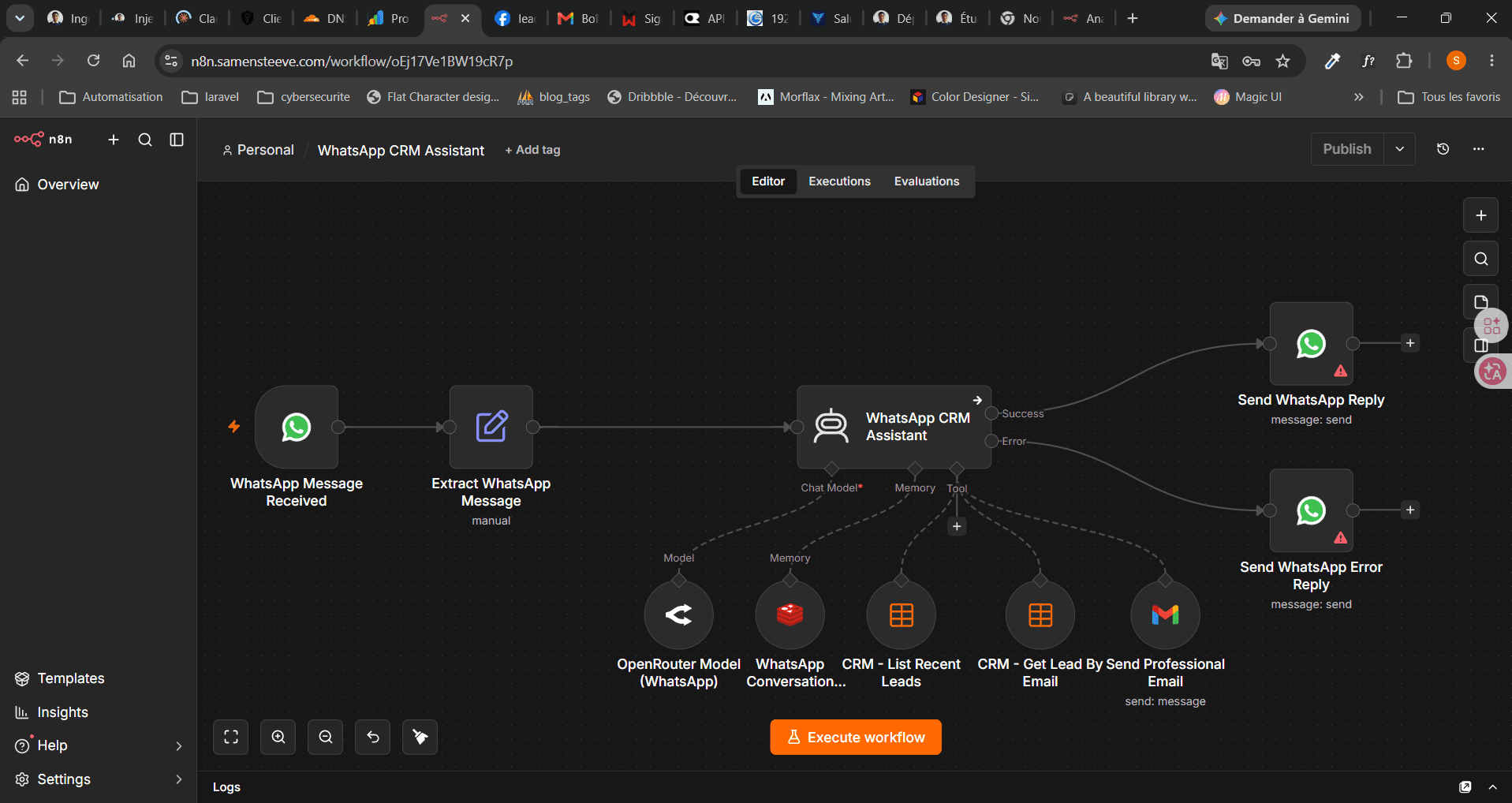
The Lead Qualification Agent doesn't run in isolation. It's part of a two-viewport lead management system sharing the same CRM Data Table:
┌─────────────────────────────────────────────────────────────────┐
│                    COMPLETE PIPELINE                             │
│                                                                 │
│  ┌──────────────────────┐         ┌──────────────────────────┐  │
│  │  Lead Qualification   │         │  WhatsApp CRM Assistant  │  │
│  │  Agent                │         │                          │  │
│  │                       │         │  WhatsApp Trigger        │  │
│  │  Form → Agent → CRM   │         │       ↓                  │  │
│  │         ↓             │         │  Agent → CRM (read)      │  │
│  │  Save Lead (write)    │         │       ↓                  │  │
│  │         ↓             │         │  Reply WhatsApp          │  │
│  │  Email notification   │         │  + send pro email        │  │
│  └──────────┬────────────┘         └──────────┬───────────────┘  │
│             │                                 │                  │
│             └─────────────┬───────────────────┘                  │
│                           ▼                                      │
│               ┌──────────────────────┐                           │
│               │  Data Table CRM      │                           │
│               │  (leads_crm)         │                           │
│               │  ─────────────────── │                           │
│               │  email, leadName,    │                           │
│               │  company, score,     │                           │
│               │  qualification,      │                           │
│               │  matchedService,     │                           │
│               │  status, notes       │                           │
│               └──────────────────────┘                           │
└─────────────────────────────────────────────────────────────────┘
The Lead Qualification Agent intercepts the form, enriches the lead via Tavily, scores it, and writes to the CRM Data Table (upsert by email — automatic deduplication).
The WhatsApp CRM Assistant allows reading and querying the same CRM in natural language from WhatsApp — check recent leads, look up by email, update status, or even send a professional email directly from the conversation.
Both agents use persistent Redis memory — conversation context is retained across sessions for continuous interaction.